Choosing the right structural system for sloping blocks

Written By
Nick Rawson

Slab on ground, bearers and joists or suspended slab? Learn which foundation works best on sloping blocks across Sydney’s North Shore and Northern Beaches.
Slab onground vs bearers and joists vs suspended slab on sloping blocks
What it means — and what works best on the North Shore and Northern Beaches
If you’re building a new home on Sydney’s North Shore or Northern Beaches, or anywhere along Sydney’s coast line and harbour inlet, chances are your block isn’t flat.
Steep streets, cross-falls, rock shelves, and layered terrain are common across suburbs like Mosman, Northbridge, Hunters Hill, Seaforth, Manly, and Avalon. One of the most important early decisions on these sites is how your home will sit on the land, yet many homeowners are introduced to terms like slab on ground, bearers and joists, or suspended slab without a clear explanation of what they actually mean.
This choice affects far more than structure. It influences comfort, ceiling heights, natural light, acoustic performance, how the home steps across the site, and ultimately how it feels to live in.
This article will delve into what they mean, as well as the pros and cons for each on sloping blocks.
Slab onground: simple on flat sites, restrictive on slopes
A slab on ground is a concrete slab poured directly onto prepared ground, with thickened edges and footings/piers for support.
Where it works:
- Flat or near flat blocks
- Minimal site fall
- Simpler layouts
Why it struggles on North Shore & Northern Beaches sites
On sloping blocks, slab on ground construction often requires forcing the land to be flat. This can mean heavy cut and fill, extensive retaining walls, and artificial level changes.
Architecturally, this can result in:
- Compromised floor to ceiling heights
- Poor relationship between levels and outdoor spaces
- Homes that feel 'perched' rather than settled into the site
- Less opportunity for split levels or natural zoning
It can work — but on steeper sites, it often limits design, compliance, quality and comfort.
Bearers and joists: adaptable, but limited for contemporary homes
Bearers and joists are a raised floor system, traditionally timber or steel, that allows a home to sit above ground level. Visualise the old Queenslanders from yester-year built on stilts, but with brick piers instead of timber.
Where it works
- Lightweight construction
- Smaller footprints
- Modest slopes
Limitations for modern custom homes
For larger, masonry-heavy homes common on the North Shore and Northern Beaches, bearer and joist systems can introduce challenges:
- Reduced acoustic separation between levels
- More noticeable floor movement
- Thermal inefficiency compared to concrete
- Difficulty achieving long spans and open plan layouts
- Less integration with basements, garages or undercroft spaces
- Doesn't feel as firm underfoot as a concrete slab
They can still be appropriate in select cases, but they’re rarely the preferred solution for high-performance, architecturally driven homes.
Suspended slab: architecture that works with the slope
A suspended slab is a reinforced concrete slab supported by piers, columns, or retaining walls, allowing the home to step naturally with the site rather than flatten it.
This approach is particularly well-suited to the sloping, rock-based sites common across Sydney’s Northern Suburbs.
Why suspended slabs suit these areas
Suspended slabs allow:
- Homes to follow the natural contours of the land
- Split level designs that feel intentional, not forced
- Better ceiling heights and spatial variation
- Stronger connection between indoor and outdoor spaces
- Improved acoustic and thermal performane
From a comfort perspective, concrete slabs also provide:
- Greater thermal mass, helping regulate internal temperatures
- Solid quiet floors underfoot
- Reduced vibration and movement over time
Architecturally, suspended slabs open up opportunities forl ight, views, and proportion that are difficult to achieve with flatter construction systems.
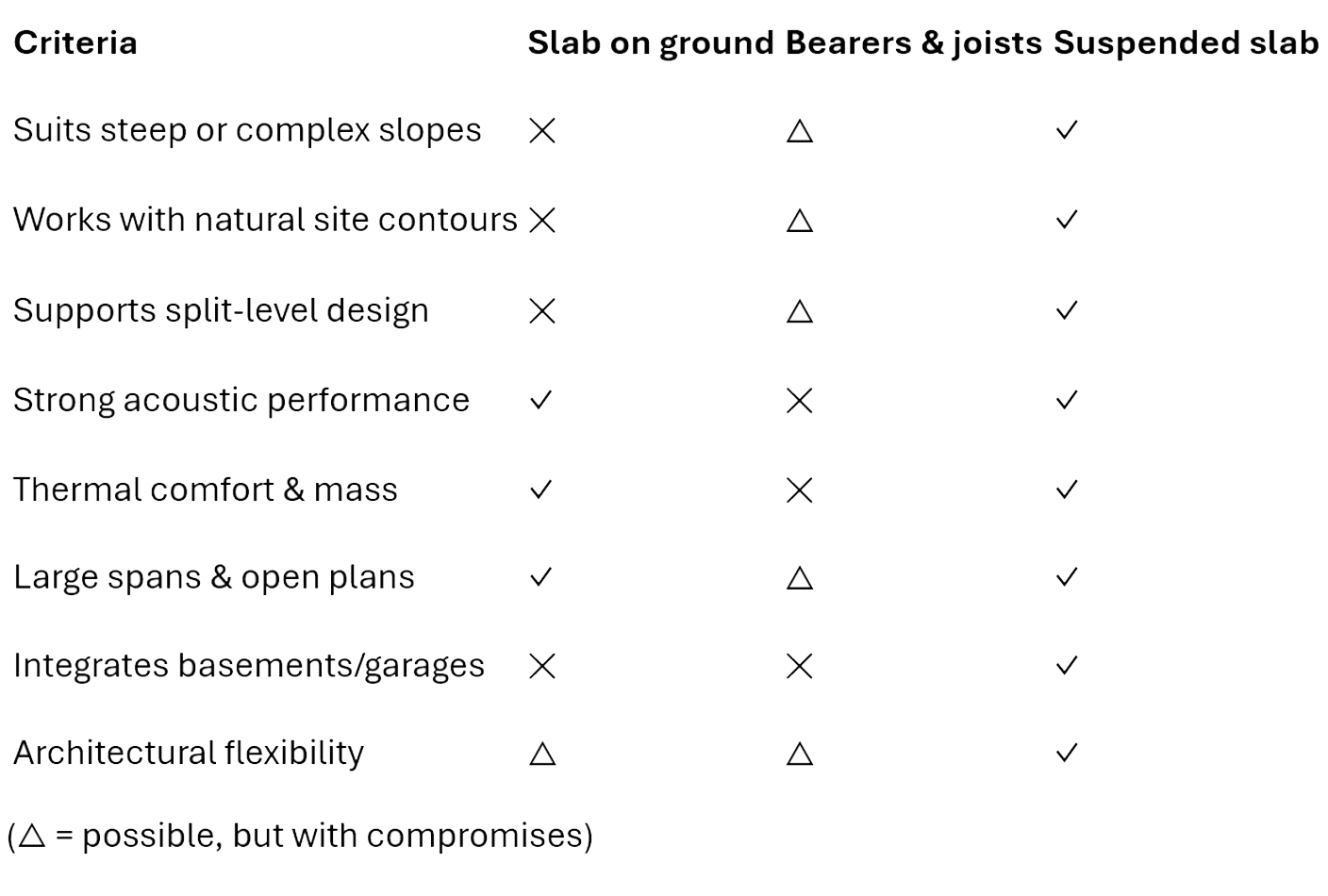
A roughcomparison: which system suits which site?
What about cost?
Suspended slabs are often perceived as the more expensive option. On genuinely flat sites, that can be true.
But on sloping blocks, the comparison is rarely simple. Once excavation, retaining, drainage, and engineering are properly accounted for, suspended slabs often provide a more predictable and resolved outcome —particularly when design quality and long-term performance are priorities.
So what’sthe right approach?
There’s no single solution that fits every block.
- Flat sites may suit slab on ground
- Mild sloped and lightweight homes may suit bearers and joists
- Steeper more complex sites particulary those across the North Shore and Northern Beaches are often best served by suspended slabs
At Hall & Hart, we generally lean toward suspended slab construction on sloping sites because it allows the architecture,structure, and landscape to work together — improving comfort, spatial quality, and longevity.
The key is addressing this decision early, alongside site analysis and design — not as a cost-driven adjustment later.
The takeaway
On sloping blocks, how your home sits on the land shapes everything that follows.
Suspended slabs aren’t just a structural choice — they’re anarchitectural one. And in many North Shore and Northern Beaches homes, they provide the most natural, comfortable, and considered outcome.
1
min read
December 23, 2025
Resources
Design Guides





.svg)


